Iranian Journal of Public Policy

Iranian Journal of Public Policy


The Iranian Journal of Public Policy is a quarterly, double-blind peer-reviewed academic journal published by the University of Tehran since 2015. The journal provides a scholarly forum for original research and critical scholarship in public policy and related fields. The journal publishes original research articles and review articles addressing theoretical, methodological, empirical, and comparative issues in public policy. Submissions are evaluated through a rigorous double-blind peer-review process to ensure the quality, originality, and academic integrity of published research. The journal is committed to open access, research integrity, transparency in scholarly publishing, and responsible editorial and peer-review practices.



Journal Title

Iranian Journal of Public Policy

P-ISSN

2538-5577

E-ISSN

2538-5089

Frequency

Quarterly

Editor-in-Chief

Hamidreza Malek Mohammadi, Ph.D.

Language 

Persian articles include extended English abstracts

Plagiarism Checker

iThenticate, Samimnoor (Persian)

Peer Review Policy

Double-blind

Article Processing Charges

See here

Average Review Time

4-8 Weeks

Acceptance Rate

18%

Owner & Publisher

University of Tehran, Iran.


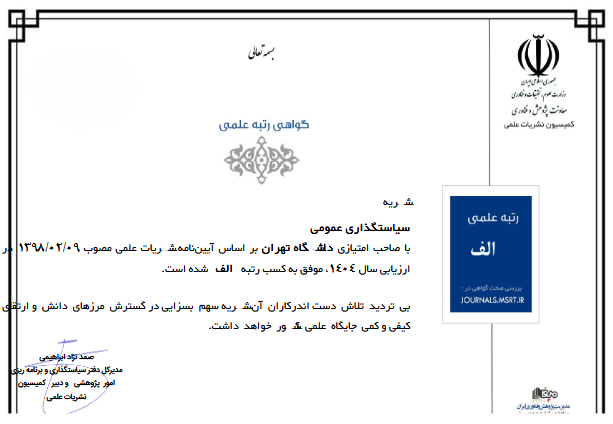
The Public Policy Quarterly of the University of Tehran (JPP) was awarded an “A” grade in the 1404 (2025–2025) evaluation of scientific journals conducted by the Ministry of Science, Research and Technology of Iran.


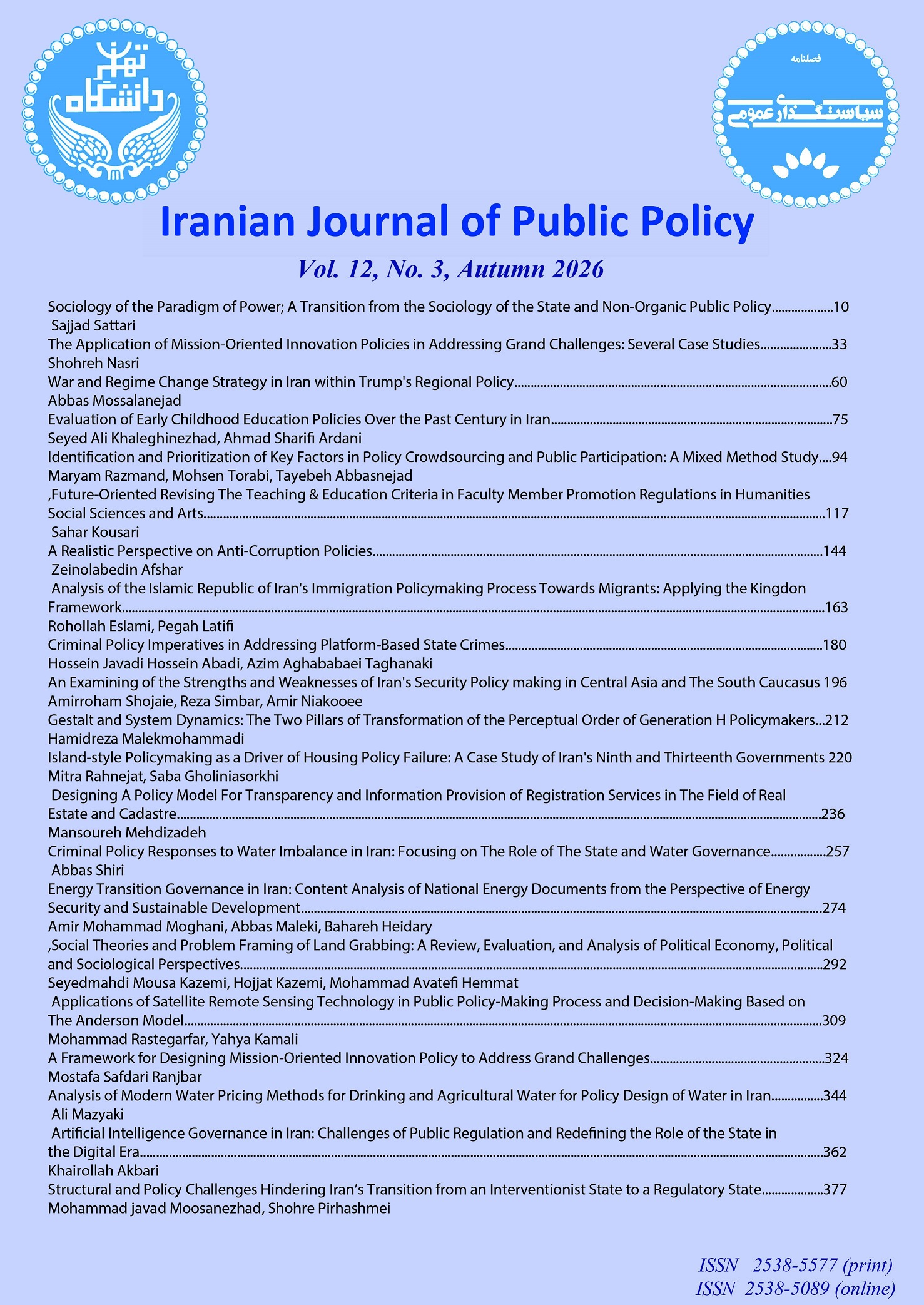
Current Issue: Volume 12, Issue 3, Autumn 2026 

Publication Information

Publisher

Director-in-Charge
Editor-in-Chief

Frequency
Quarterly
Print ISSN
Online ISSN

Indexing and Abstracting

Keywords Cloud

  • Public Policy
  • Iran
  • Policy making
  • Governance
  • Policy evaluation
  • Policy
  • Criminal policy
  • Thematic analysis
  • Policy Analysis
  • Grounded theory
  • Artificial Intelligence
  • Policymaking
  • Higher Education
  • Policy-making
  • Policy
  • Meta-synthesis
  • cultural policy
  • Content analysis
  • corruption
  • Public policy making
  • Islamic Republic of Iran
  • Water governance
  • Systematic review
  • Development
  • Regulation
  • Comparative Study
  • Iran
  • policy implementation
  • Sustainable Development
  • government
  • Policy design
  • Decision making
  • Policy formulation
  • Accountability
  • cyberspace
  • Seventh Development Plan
  • Educational Policy
  • Innovation
  • Decentralization
  • implementation
  • Foreign Policy
  • transparency
  • Industrial policy
  • Wicked Problems
  • climate change
  • developmental state
  • innovation policy
  • pathology
  • Public Participation
  • discourse
  • network governance
  • Scenario
  • politics
  • Foresight
  • Policy Process
  • Futures Studies
  • Social media
  • Identity
  • environment
  • Conflict of interest
  • Policy Package
  • Good Governance
  • participation
  • Saudi Arabia
  • Insurance
  • Science
  • Culture
  • Qualitative Content Analysis
  • Systematic literature review
  • public policymaking
  • Tax
  • Institutions
  • critical discourse analysis
  • Mission-Oriented Innovation Policy
  • Family Policy
  • Interpretive structural modeling
  • Typology
  • National Innovation System
  • Political Science
  • Iraq
  • Public Sector
  • state
  • Developing Countries
  • Housing Policy
  • System Dynamics
  • Policy Learning
  • Strategy
  • path dependency
  • resilience
  • Blockchain
  • Qualitative research
  • political economy
  • Data Governance
  • Institutionalism
  • Policy Instruments
  • Sustainable Development
  • Democracy
  • Advocacy Coalition Framework
  • policy capacity
  • Macro Policies
  • Policy Mix
  • Policy Instrument
  • public administration
  • legitimacy
  • implementation research
  • Digital economy
  • Banking System
  • Health System
  • Covid-19
  • Entrepreneurship
  • Prioritization
  • Stakeholders
  • Effectiveness
  • Islamic Revolution
  • Digital governance
  • Problem
  • Evaluation
  • Federal
  • Innovation Ecosystem
  • Institutional mapping
  • Scientometrics
  • Integration
  • Intellectual Property
  • Internet Governance
  • Unintended Consequences
  • Performance
  • power structure
  • Expediency Discernment Council
  • Anti-money laundering
  • Science Policy
  • Environmental policy
  • Business Ecosystem
  • Education
  • natural gas
  • Decision
  • Food security
  • animation
  • Legislation
  • New public management
  • imprisonment
  • Change
  • Social Engineering
  • Context
  • Sabatier
  • hollow state
  • Housing
  • Models
  • Policy Cycle
  • scenario planning
  • methodology
  • nudge
  • Public Policy-Making
  • Urban Policy
  • Evaluability
  • Future Studies
  • Grand challenge
  • Banking
  • Power Distribution
  • authoritarianism
  • Water policy
  • Program Theory
  • Water management
  • Women
  • regulatory
  • Scenario writing
  • Oil rent
  • Lake Urmia
  • Rentier economy
  • Constitution
  • Causal Layered Analysis
  • OPEC
  • OECD
  • Merchandising
  • policy conflict
  • E-Government
  • Centralized
  • Health policy
  • prison
  • Qualitative meta-analysis
  • Market Failure
  • Brain Drain
  • Social Citizenship
  • Policy making
  • Big data
  • network analysis
  • Public Sphere
  • Functional Analysis
  • economic sanctions
  • Cultural Revolution
  • Tragedy of the Commons
  • upstream documents
  • Planning
  • Cooperation
  • comparative analysis
  • War
  • policies
  • Rationality
  • free zones
  • Social Network Analysis (SNA)
  • Economic policy