Iranian Journal of Public Policy

Iranian Journal of Public Policy


The Iranian Journal of Public Policy is a quarterly, double-blind peer-reviewed academic journal published by the University of Tehran since 2015. The journal provides a scholarly forum for original research and critical scholarship in public policy and related fields. The journal publishes original research articles and review articles addressing theoretical, methodological, empirical, and comparative issues in public policy. Submissions are evaluated through a rigorous double-blind peer-review process to ensure the quality, originality, and academic integrity of published research. The journal is committed to open access, research integrity, transparency in scholarly publishing, and responsible editorial and peer-review practices.



Journal Title

Iranian Journal of Public Policy

P-ISSN

2538-5577

E-ISSN

2538-5089

Frequency

Quarterly

Editor-in-Chief

Hamidreza Malek Mohammadi, Ph.D.

Language 

Persian articles include extended English abstracts

Plagiarism Checker

iThenticate, Samimnoor (Persian)

Peer Review Policy

Double-blind

Article Processing Charges

See here

Average Review Time

4-8 Weeks

Acceptance Rate

18%

Owner & Publisher

University of Tehran, Iran.


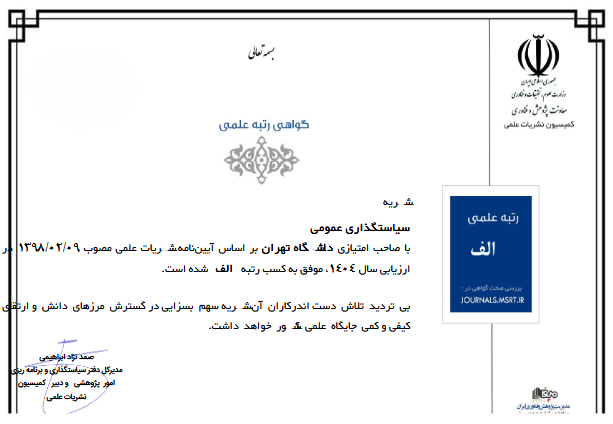
The Public Policy Quarterly of the University of Tehran (JPP) was awarded an “A” grade in the 1404 (2025–2025) evaluation of scientific journals conducted by the Ministry of Science, Research and Technology of Iran.


Current Issue: Volume 12, Issue 3, Autumn 2026 

Publication Information

Publisher

Director-in-Charge
Editor-in-Chief

Frequency
Quarterly
Print ISSN
Online ISSN

Indexing and Abstracting

Keywords Cloud

  • Public Policy
  • Iran
  • Policy making
  • Governance
  • Policy evaluation
  • Criminal policy
  • Policy
  • Grounded theory
  • Policy Analysis
  • Thematic analysis
  • Artificial Intelligence
  • Higher Education
  • Policymaking
  • Policy-making
  • Policy
  • Content analysis
  • Meta-synthesis
  • cultural policy
  • corruption
  • Systematic review
  • Islamic Republic of Iran
  • Water governance
  • Comparative Study
  • Public policy making
  • Development
  • Regulation
  • policy implementation
  • Policy design
  • Sustainable Development
  • government
  • Iran
  • Policy formulation
  • Decision making
  • pathology
  • Accountability
  • Foreign Policy
  • Innovation
  • transparency
  • Wicked Problems
  • Decentralization
  • Educational Policy
  • Industrial policy
  • developmental state
  • cyberspace
  • climate change
  • innovation policy
  • Seventh Development Plan
  • implementation
  • discourse
  • Public Participation
  • participation
  • network governance
  • Scenario
  • Identity
  • environment
  • politics
  • Good Governance
  • Futures Studies
  • Policy Process
  • Social media
  • Conflict of interest
  • Foresight
  • resilience
  • Saudi Arabia
  • Prioritization
  • Insurance
  • Science
  • Culture
  • public administration
  • Qualitative Content Analysis
  • Systematic literature review
  • public policymaking
  • Policy Package
  • Tax
  • Data Governance
  • Developing Countries
  • Political Science
  • System Dynamics
  • National Innovation System
  • Housing Policy
  • path dependency
  • Strategy
  • Policy Learning
  • Typology
  • Iraq
  • state
  • Public Sector
  • Effectiveness
  • Mission-Oriented Innovation Policy
  • Institutionalism
  • Blockchain
  • Qualitative research
  • political economy
  • policy capacity
  • Family Policy
  • Sustainable Development
  • Institutions
  • Policy Instruments
  • critical discourse analysis
  • Macro Policies
  • Democracy
  • Policy Instrument
  • Policy Mix
  • Digital economy
  • Advocacy Coalition Framework
  • Banking System
  • Health System
  • Covid-19
  • implementation research
  • Entrepreneurship
  • Stakeholders
  • legitimacy
  • animation
  • Islamic Revolution
  • Internet Governance
  • Evaluation
  • Scientometrics
  • Digital governance
  • Food security
  • Unintended Consequences
  • Federal
  • Integration
  • Anti-money laundering
  • Expediency Discernment Council
  • Intellectual Property
  • Performance
  • power structure
  • Institutional mapping
  • Decision
  • Business Ecosystem
  • Education
  • comparative analysis
  • Innovation Ecosystem
  • educational Justice
  • Housing
  • Power Distribution
  • Legislation
  • New public management
  • natural gas
  • hollow state
  • imprisonment
  • Context
  • Environmental policy
  • Social Engineering
  • methodology
  • Models
  • Sabatier
  • Policy Cycle
  • Public Policy-Making
  • scenario planning
  • Grand challenge
  • Urban Policy
  • nudge
  • Change
  • Science Policy
  • Causal Layered Analysis
  • authoritarianism
  • policies
  • Program Theory
  • Women
  • Cultural Revolution
  • Constitution
  • Brain Drain
  • Scenario writing
  • Oil rent
  • Market Failure
  • Lake Urmia
  • Future Studies
  • War
  • OECD
  • OPEC
  • Qualitative meta-analysis
  • E-Government
  • Merchandising
  • Centralized
  • policy conflict
  • Rentier economy
  • network analysis
  • Policy making
  • Social Citizenship
  • Big data
  • Health policy
  • Cooperation
  • Interpretive structural modeling
  • Water policy
  • economic sanctions
  • Water management
  • Tragedy of the Commons
  • Public Sphere
  • regulatory
  • prison
  • Banking
  • Justice
  • Metaphor
  • Rationality
  • Multiple streams framework
  • Social Network Analysis (SNA)
  • Economic policy
  • South Caucasus
  • Regulatory Impact Assessment